
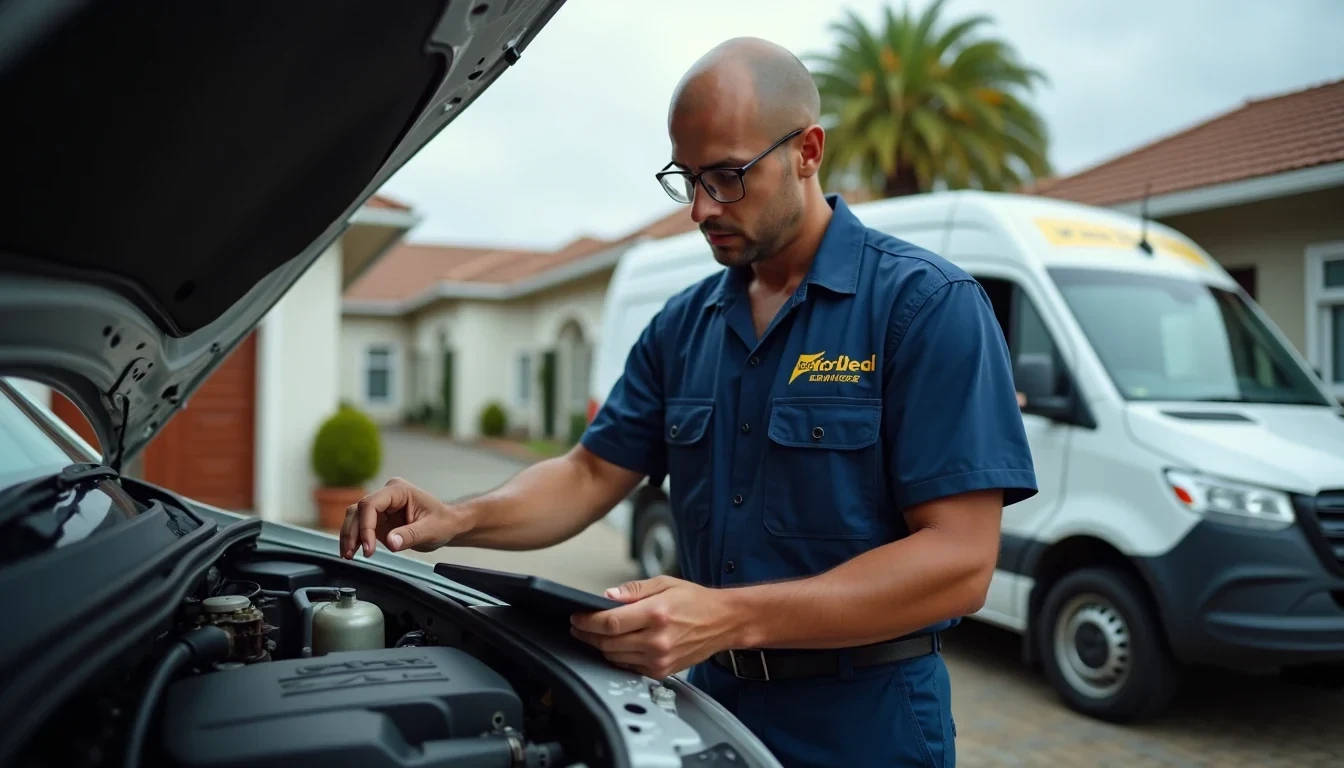
A lead mechanic named Dayne has spent more than a decade fixing vehicles in Cape Town. These days he rarely works from a bay. Instead, his diagnostic equipment, genuine parts inventory, and tool sets travel with him to driveways, office parking lots, and roadside breakdown sites across the metro. This reflects a structural change in how vehicle maintenance fits into the schedules of working professionals and small business owners who cannot afford to lose half a day to workshop queues.
Mobile mechanic operations have matured beyond the roadside assistance model of jump-starts and tyre changes. Technicians now arrive with SAE International-compliant diagnostic systems and perform complete engine assessments, brake system overhauls, and routine servicing without the vehicle ever entering a workshop. For Cape Town’s spread-out geography, where a Bellville resident might work in Claremont and socialise in Hout Bay, this removes a logistical friction from vehicle ownership.
How the Service Actually Works
The booking process follows a four-step sequence designed to minimise uncertainty. A customer initiates contact through phone, WhatsApp, or an online form. Within a short turnaround, they receive a detailed cost estimate with no obligation to proceed. A qualified technician then travels to the specified location with the necessary equipment and parts, completes the work, and tests the vehicle before departure.
This structure directly addresses a persistent pain point in traditional garage servicing: the opacity of final bills. Workshop customers frequently encounter additional charges discovered mid-repair, communicated by phone while the vehicle is already immobilised. The mobile model’s upfront quotation, delivered before any physical work begins, removes that leverage imbalance. Customers know the full cost before committing, and they retain the option to decline or seek comparison quotes.
Dayne’s operation, alongside comparable services, maintains 24/7 emergency availability. For critical failures, typical arrival times run to within a few hours rather than days. Small businesses dependent on single vehicles for deliveries, client visits, or equipment transport face a day’s lost productivity that often exceeds the repair cost itself.
Coverage and Local Reach
The geographic spread of mobile mechanic services now encompasses the full Cape Town metro and surrounding nodes. Operations extend from the Atlantic Seaboard through to the northern suburbs, with technicians regularly serving Sea Point, Hout Bay, Bellville, Durbanville, Claremont, and Rondebosch.
This breadth is not incidental. Cape Town’s traffic patterns and infrastructure constraints make cross-town vehicle movement costly in time and fuel. A Durbanville resident whose vehicle develops a fault during a workday in the city bowl faces an unappealing choice: attempt the drive home with a compromised vehicle, or arrange towing to a nearby workshop and coordinate collection later. Mobile service collapses that decision into a single call.
The iCar Mechanical Repairs model, representative of the broader sector, sends equipped vehicles rather than bare technicians. These mobile units carry advanced diagnostic technology, genuine manufacturer components, and specialised tooling that matches the capability of fixed workshop bays. The majority of automotive work, including complex diagnostic tasks, can be completed at the customer’s location without workshop visits.
Standards and Compliance
Quality assurance in mobile mechanic work rests on several explicit pillars. All repair and maintenance work must conform to National Road Traffic Act standards, the same regulatory framework governing brick-and-mortar facilities. Technicians operate with qualifications and experience comparable to workshop staff; Dayne’s ten-plus years in the field is typical of the sector’s established operators.
Diagnostic accuracy depends on equipment calibration and protocol adherence. Mobile services use modern diagnostic systems that follow technical standards established by SAE International, the engineering body whose protocols underpin vehicle fault identification globally. Accurate first diagnosis prevents the costly cascade of unnecessary part replacements.
The Automobile Association of South Africa has consistently emphasised consistent vehicle care as essential for both performance and safety. Mobile mechanics operationalise this principle by reducing the friction that otherwise delays routine maintenance. Owners who might postpone servicing due to scheduling constraints can now address minor issues before they compound into major failures.
Service guarantees provide the final layer of accountability. Reputable mobile operations stand behind their workmanship with explicit guarantees, creating recourse comparable to that available at established workshops. The combination of qualified personnel, regulated standards, and guaranteed output produces professional standards that the sector itself claims match fixed facilities.
Cost Structure and Hidden Savings
Direct labour rates between mobile mechanics and traditional garages often prove competitive. The real financial differentiation lies in eliminated ancillary costs and avoided opportunity losses.
Towing fees represent the most visible saving. A non-drivable vehicle typically requires transport to a workshop at the owner’s expense, with costs scaling by distance and time of day. Mobile service removes this entirely for repairs that can be completed on-site. Fuel costs for multiple trips to drop off and collect vehicles disappear similarly. For professionals billing hourly or managing client-facing schedules, the avoided downtime frequently exceeds the direct service cost.
Transparent pricing models reinforce this advantage. Free, detailed, no-obligation quotes delivered before work commences allow genuine comparison shopping and budget certainty. The traditional workshop model, where final costs emerge only after disassembly and inspection, inherently disadvantages the customer in information asymmetry.
What to Evaluate When Choosing a Service
Several concrete indicators distinguish reputable mobile mechanics from less reliable operators. Prospective customers should verify:
- Explicit qualification claims and years of experience, such as Dayne’s decade-plus track record
- Clear statement of compliance with National Road Traffic Act standards
- Upfront quotation practices with no obligation
- Explicit service guarantee terms
- Equipment descriptions indicating SAE International protocol adherence
- Geographic coverage matching the customer’s regular locations
- Multiple contact channels including phone, WhatsApp, and web forms
Response time commitments for emergencies provide a further differentiator. Same-day appointment availability for critical issues, with arrival within hours for genuine emergencies, separates operations with genuine capacity from those overstretched or operating as referral aggregators without direct technician deployment.
The Broader Shift in Vehicle Maintenance
Mobile mechanic services represent one component of a larger restructuring in automotive after-sales service. The traditional workshop model assumed vehicle owners with flexible schedules, alternative transport options, and tolerance for procedural friction. That assumption fits poorly with contemporary work patterns, particularly for professionals in dual-income households, gig economy drivers, and small business operators without fleet redundancy.
The Cape Town context amplifies these pressures. The city’s spatial geography, with employment and residential nodes distributed across a wide metro area, multiplies the cost of any single workshop visit. Traffic congestion on key arterials during business hours converts short distances into long travel times. Parking constraints at many workshop locations add further friction.
By inverting the service model and bringing technician capacity to the vehicle’s location, mobile mechanics align maintenance activity with actual customer constraints rather than requiring customers to adapt to workshop logistics. The technical capability now exists to perform sophisticated diagnostic and repair work outside fixed facilities, validated by the same regulatory standards and professional protocols.
For vehicle owners across the Cape Town metro, from Atlantic Seaboard apartment blocks to northern suburb office parks, this shift converts vehicle maintenance from a scheduled disruption into a background service. The workshop comes to the driveway. The diagnostic equipment travels to the parking bay. The ten-year veteran technician arrives with tools, parts, and a guarantee, ready to work while the owner continues their day uninterrupted.